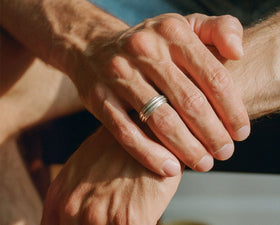
How to Find the Perfect Ring Size
Hands down the most common customer inquiry I get, regardless if someone is purchasing a ring for themselves or for someone else, is how to make sure they have the right ring size. In this article I explain why it’s such an infuriatingly confounding endeavor, and provide some tips that can hopefully help anyone shopping for rings.
Hands down the most common customer inquiry I get, regardless if someone is purchasing a ring for themselves or for someone else, is how to make sure they have the right ring size.
I get asked about it so often that I’m literally writing this piece not only to help others, but also to save myself from repeating the same spiel over and over again — I know future Kelsey (and hopefully future customers!) will be grateful.
So why is nailing a ring size so difficult? Let’s get into it.

FINGERS ARE FICKLE
The first reason finding a perfect fit feels impossible is because you’re trying to pin down a moving target.
Fingers can grow and shrink over time due to age and specific life experiences — I don’t have enough fingers to count how many rings I’ve resized after someone’s had a baby! Fingers can also fluctuate season to season, day to day, and even hour to hour depending on things like temperature, diet, and alcohol consumption.
A few years ago, during my friends’ wedding ceremony, it was time to exchange rings, and I was horrified when the groom’s wedding band didn’t fit. Having been the one who made the band, I sat in the crowd thinking that maybe I had completely messed up his ring size.
He was a great sport and wore the band on his pinky finger for the rest of the evening (it was actually a pretty sick look and made me think that maybe pinky wedding bands should be a thing?), however, I was relieved the next day when I got a text from the couple saying the ring now fit perfectly on the intended finger.
The culprit? The groom had just eaten too much salty food the day before the wedding.

EVEN THE TOOLS ARE IMPERFECT
Another reason why ring sizing is such a challenge is the simple fact that jewelry-making tools aren’t perfectly calibrated to one another.
Similar to how jean sizes never seem to be consistent from brand to brand, one jeweler’s ring sizing tools might be slightly different from another jeweler’s ring forming tools, and equipment belonging to the same jeweler might even have slight discrepancies.
While it feels crazy that tools used to literally measure things aren’t themselves perfectly standardized, it’s unfortunately a reality of the trade.
THE RING ITSELF MATTERS
A third variable to throw into the mix is that a ring’s style also affects how it fits.
A thin band will generally be more forgiving and tends to fit looser, while a thicker band will feel tighter on the finger (I think this has something to do with surface area and friction, idk exactly tbh). This is also why rings stacked together feel more snug as a group.
So, for example, if someone is a size 6 in the original Side Set Ring, which has a 2.5mm-wide band, I would recommend they order at least a half size up in the Wide Side Set Ring, which has a 5mm-wide band.

Of course, how tightly a ring fits is also a matter of personal preference. Some people feel claustrophobic if their rings fit too tightly; others plan to never take them off and want a snug fit. So there’s really no single “correct” fit — it’s also about what feels comfortable to you.
LETTING GO OF THE PERFECT FIT
I’m dumping all of this information here not to discourage you, but hopefully to relieve some of the pressure that comes with searching for the PERFECT ring size — because, as you can see, it kind of doesn’t exist.
What I tell my customers is that the best we can do is get as close as we can, with the understanding that some days your rings might fit better than others, and on some days they might have to take up temporary residency on other fingers. Or take the day off completely, chilling on your nightstand (when I was in Italy earlier this summer, I legitimately didn’t wear my rings for an entire week because my body was so bloated from all the delicious carbs I was eating — worth it).
Another thing that should put your mind at ease: fine jewelry is a malleable-ish medium, and most rings can be resized up or down. Exactly how much and how easily depends on the specific ring design, of course, so if you’re unsure, chat with your jeweler and ask what they recommend.

For example, it’s much easier and cheaper to size a Column Stack Ring down, so I always recommend sizing up if someone is deciding between two sizes.

A ring featuring an eternity setting, however, such as the Column Stack Ring with Pavé Diamonds, is a little trickier. This style can’t be resized because of the nature of the stone settings; it would need to be remade instead — a process that obviously costs more than a typical resizing.
For investments like these (or for perfectionists who want to get as close to a “perfect” fit as possible), I recommend committing to measuring your fingers sporadically over a longer period of time — ideally at least 2–3 months, and in a variety of conditions.
Think of it as collecting data points rather than trying to find one magical number. Measure at different times of day, in different temperatures, and after different activities. Then you can look at the range and find a size that should work comfortably most of the time.
BONUS ROUND:
HOW TO FIND SOMEONE ELSE'S RING SIZE WITHOUT THEM KNOWING
Sometimes people want to purchase a ring for someone whose size they don’t know, but would like to keep the purchase a secret (obviously engagement rings are the common culprit here).
This obviously makes the whole endeavor significantly more challenging, but as a bonus section, here are the methods I recommend most for sneakily but somewhat reliably finding out someone’s ring size without them knowing:
STEAL THEIR RINGS
If you have access to their existing rings, sneakily steal one and be sure to note which finger they wear it on (each finger can be a different size, and even the same finger on different hands can be different sizes).
The best way to figure out the size would be to bring the ring to a jeweler, but if you can’t get away with that, grab a ruler — ideally one with millimeter measurements — and measure the internal diameter of the ring.
If possible, take a bird’s-eye view photo of the ring sitting on top of the ruler. That way, your jeweler can see both the measurement and the style of the band, which is important given everything I just explained above about different ring styles fitting differently.

USE YOUR FRIENDS
Employ one or more accomplices to take the target out shopping and casually mention that they’ve been wanting to buy a ring and need to get their fingers sized.
Once they’re at a jewelry store or pop-up, it should be pretty easy to convince them to get their fingers sized, too. It’s a fun activity! Kind of like reading horoscopes. Peer pressure works in your favor here. Then have your friends report back.
—
These are the two methods I’ve found to be the most accurate and least suspicious, but please shout if you have another approach you swear by. I need more ideas!
Okay, so there you have it — my ring sizing spiel, finally written down for easy reference and sharing. I hope that it’s more helpful than discouraging, and I might have forgotten something — so if you’re a jeweler reading this, please chime in! And if you’re shopping for a ring and have any questions, don’t hesitate to reach out.